Uncategorized
Microdosing Psilocybin in Canada: A Practical, Evidence-Informed Guide
Oct
Microdosing Psilocybin in Canada: What You Need to Know
Microdosing psilocybin has moved from niche internet forums into mainstream Canadian conversation. Search interest in microdosing mushrooms has grown steadily alongside broader curiosity about psilocybin Canada, magic mushroom strains, and psychedelic therapy. But much of what circulates online is anecdotal, exaggerated, or simply wrong.
This guide takes a calmer, evidence-informed approach. It explains what microdosing actually is, what the current research does and does not support, how common protocols are structured, how to think about dosing and safety, and where Canadian law stands in 2026. It is educational content, not medical advice — anyone with a health condition, or who takes prescription medication, should speak with a clinician before experimenting.
If you are new to the broader subject, start with our Canada Magic Mushrooms dispensary guide for foundational context on psilocybin, strains, and effects before diving into microdosing specifics.
What Is Microdosing Psilocybin?
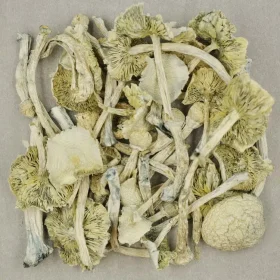
Microdosing means taking a very small, sub-perceptual dose of a psychedelic — typically 5–10% of a full recreational dose — on a repeating schedule. With psilocybin, that usually works out to roughly 0.05–0.3 grams of dried mushrooms, depending on the strain and the person. The goal is not to trip. The goal, as users describe it, is to feel subtly more focused, creative, or emotionally balanced without altered perception.
That distinction matters. A microdose should not produce visual distortions, pronounced euphoria, or a sense of losing control. If it does, the dose was too high — that is a mini-dose, not a microdose.
Microdosing vs. a Full Psilocybin Experience
A full psilocybin experience involves meaningful perceptual and emotional changes and typically lasts four to six hours. Microdosing sits at the opposite end of the spectrum: subtle, short-lived, and intended to fit into an ordinary workday. The two are not interchangeable, and the evidence base for each is different. For a deeper look at how psilocybin affects the brain and body at larger doses, see our overview of psilocybin effects and magic mushroom basics.
What the Research Actually Says
This is where honesty matters most. Despite enormous popular interest, high-quality clinical evidence on microdosing is still thin. Most studies to date are small, short, or observational, and several well-designed placebo-controlled trials have produced modest or null results.
What Studies Have Found
- Mood and wellbeing: Some observational studies report improvements in mood, focus, and life satisfaction among microdosers. However, placebo-controlled trials have generally found that much of the perceived benefit may be attributable to expectation rather than the substance itself.
- Creativity and cognition: Results are mixed. A few small studies suggest subtle changes in divergent thinking, but effects are inconsistent and not reliably reproduced.
- Safety signals: Short-term adverse effects reported in the literature are usually mild — headache, mild anxiety, sleep changes, or transient fatigue. Serious adverse events in healthy adults at microdoses are rare in the published data, but long-term data are essentially absent.
What We Still Don’t Know
We lack long-term safety data, standardized dosing, and large randomized trials. Questions about tolerance, cardiovascular effects, and interactions with SSRIs and other medications remain incompletely answered. Anyone presenting microdosing as a proven therapeutic intervention is overstating the evidence.
For a fuller picture of the clinical research landscape in this country, our article on psilocybin research and clinical trials in Canada covers the major studies and what they mean for patients.
Common Microdosing Protocols
There is no single official protocol. Three approaches dominate user reports and online discussion. None has been validated in large trials, so treat these as descriptions of common practice rather than prescriptions.
The Fadiman Protocol
One dose day, followed by two days off, repeated in a cycle. For example: dose Monday, skip Tuesday and Wednesday, dose Thursday, and so on. This is the most widely cited schedule and is often recommended for beginners because the frequent off-days make it easier to observe effects and avoid tolerance.
The Stamets Protocol
Four consecutive dose days followed by three days off. Some versions pair psilocybin with lion’s mane and niacin, though the added ingredients are not part of the psilocybin evidence base. This schedule is more intensive and is generally not recommended as a starting point.
Every-Other-Day and Intuitive Schedules
Some people dose every second day; others dose only when they feel they need it. Intuitive schedules are flexible but harder to evaluate, because without a consistent pattern it is difficult to tell what is working.
How Long Do People Microdose?
Many users report cycles of four to eight weeks followed by a break. There is no established safe duration. Taking regular tolerance breaks is a sensible precaution given the absence of long-term data.
How to Think About Dosage
Dosing is strain-dependent and individual. Golden Teacher mushrooms and Penis Envy mushrooms, for example, differ substantially in potency — Penis Envy is notably stronger, so a microdose of one is not equivalent to a microdose of the other. This is one reason starting low and going slowly is the universal recommendation.
A practical approach many people use:
- Start at the very low end — around 0.05 g of a moderate-potency strain.
- Observe for a full day before adjusting.
- Increase in small increments only if the dose is genuinely sub-perceptual.
- Keep a simple log of dose, strain, schedule, sleep, and mood.
For a more detailed breakdown of dose ranges and what to expect at each level, see our guide to magic mushroom dosage.
Safety Considerations
Microdosing is generally described as low-risk for healthy adults, but “low-risk” is not “no-risk.” Key considerations include:
- Mental health history: People with a personal or family history of psychosis, bipolar disorder, or schizophrenia should avoid psilocybin entirely unless under specialist care.
- Medications: SSRIs, SNRIs, lithium, and some other drugs can interact with psilocybin. Serotonin syndrome is rare but possible; lithium combinations are considered particularly risky.
- Pregnancy and breastfeeding: There is no safety data. Avoid.
- Cardiovascular conditions: Psilocybin can temporarily raise heart rate and blood pressure.
- Driving and operating machinery: Even sub-perceptual doses can affect attention in some people. Do not assume you are unaffected.
For a fuller list, read our article on magic mushroom side effects and psilocybin side effects.
The Legal Picture in Canada
Psilocybin remains a controlled substance in Canada. Outside of specific exemptions — such as certain clinical trials, palliative care exemptions, and Section 56 exemptions granted on a case-by-case basis — possession and sale are not legal. Some dispensaries operate openly in certain cities, but that does not make the activity lawful, and enforcement varies.
This is a genuinely important point for anyone considering microdosing. The legal landscape is evolving, and 2026 has seen continued discussion about regulatory reform, but no broad legalization has occurred. Our detailed explainer on whether magic mushrooms are legal in Canada covers the current rules, exemptions, and what they mean in practice.
Frequently Asked Questions
Is microdosing psilocybin legal in Canada?
No, not generally. Psilocybin is a controlled substance. Limited exemptions exist for clinical trials, some palliative care patients, and specific Section 56 approvals. Recreational possession and sale remain illegal outside those frameworks.
How much is a microdose of mushrooms?
Typically 0.05–0.3 g of dried mushrooms, depending on strain potency and individual sensitivity. Start at the low end. A true microdose should not produce noticeable perceptual effects.
Can microdosing help with depression or anxiety?
The evidence is not yet strong enough to say. Some observational reports are positive, but placebo-controlled trials have been mixed. Psilocybin-assisted therapy at full doses has shown more promise in clinical settings, but that is a different intervention from microdosing.
How long does a microdose last?
Effects, when noticeable at all, typically last a few hours. Most users report subtle changes rather than a distinct “high.”
Can I microdose while taking antidepressants?
Speak with a clinician first. SSRIs and other serotonergic medications can interact with psilocybin, and the combination is not well studied. Do not adjust prescribed medication on your own.
Do I need to take a break from microdosing?
Most experienced users cycle on and off rather than dosing indefinitely. Given the lack of long-term safety data, regular breaks are a reasonable precaution.
The Bottom Line
Microdosing psilocybin is a genuinely interesting area of inquiry, but it is not a proven therapy, and the hype online outruns the science. If you are curious, approach it with realistic expectations, start low, keep notes, respect the legal situation in Canada, and involve a healthcare professional if you have any health conditions or take medication. For broader context on strains, effects, and safe use, explore the Canada Magic Mushrooms resource library.
